If you’ve ever lifted a bucket or extended a grapple and felt your skid steer start to tip, even well within your machine's rated operating capacity, you’ve probably had a lesson in balance.
There’s likely nothing wrong with your machine and the numbers aren’t wrong. The truth is, rated capacity (ROC) isn’t a promise of stability. It’s a starting point. A static, controlled test number that assumes a low, centered load on flat ground.
It’s not just capacity you have to consider when it comes to real-world stability. The moment you lift, reach forward, or hit uneven terrain, your balance point shifts fast.
So how do you know when your machine is reaching its limits? Let’s break it down.
ROC is the baseline load a skid steer can handle safely under ideal conditions — low, centered load, flat ground. It’s tested under controlled conditions and includes a safety margin.
For context, ROC is usually roughly half of a machine’s tipping load for wheeled skid steers, and slightly less for tracked machines, depending on the manufacturer. The tipping load is the actual weight that the machine reaches its tipping point, measured with the load near the attachment pivot on level ground.
Bottom line: being within ROC doesn’t guarantee your skid steer will feel stable. As soon as you lift, extend, or operate on uneven terrain, the balance point shifts.
How Machine Design Affects Balance
Not all machines handle the same way. Here are some skid steer design factors that influence stability:
Tracks vs. tires — tracks provide more surface contact and traction, improving stability on soft or uneven ground.
Weight distribution — rear-heavy machines feel more planted; front-heavy machines may feel tippy when lifting.
Even within ROC, a compact machine with a short wheelbase may feel “light” at the rear when lifting heavy attachments, while a wider machine feels solid.
How Attachments Affect Balance
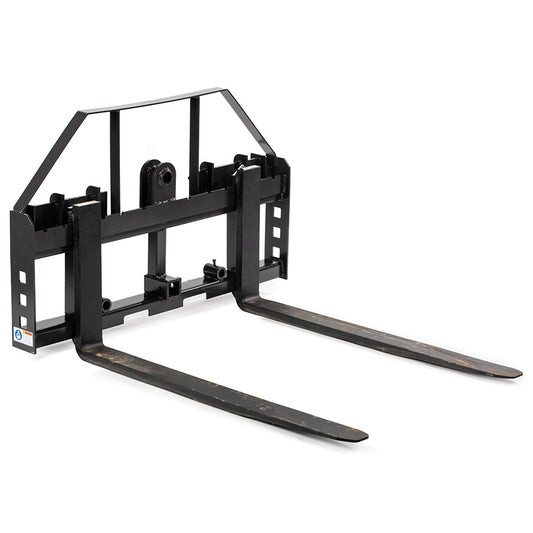
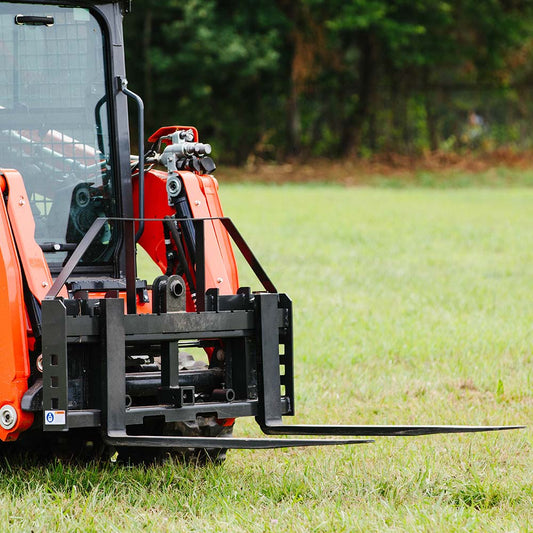
Attachments eat into useable capacity, but they also shift balance forward. A heavy bucket, extended forks, or a long grapple can make your machine feel unstable even if it’s technically within ROC.
Pro tip: Always check both the weight and geometry of your attachments before lifting. A lighter grapple can feel less stable than a heavier bucket if it extends farther forward.
Remember: a skid steer doesn’t tip because it’s overloaded — it tips because the balance point moves outside the machine’s footprint. Be aware that the farther you extend an attachment, the more it's going to affect your balance.
Featured Categories
Skid Steer Attachments for Clearing Land, Hauling & Digging
Even a perfectly loaded skid steer can feel unstable on uneven ground. Balance isn’t just about weight and how you use your attachments — terrain affects center of gravity, traction, and tipping point. Here are some things to watch out for:
Slopes or side-hilling reduce lateral stability. Travel up and down slopes, not across them, whenever possible.
Soft or uneven ground can let one side settle, causing tipping. Keep loads as low as possible when moving over uneven ground to reduce tipping.
Ruts and bumps make steering unpredictable. If the ground feels questionable, stop and reassess before lifting or reaching forward.
Adjusting speed, direction, and load height based on ground conditions are imperative for staying in control on unpredictable terrain.
3 Point Ballast Box Fits Category 2 Tractors
Regular price
$919.99
Sale price
$774.97
15% off (Save $145)
Enhance your tractor's front axle integrity and traction by adding weight with a Ballast Box.
ROC, tipping load, and other specifications give you a baseline for what your machine can handle. In real-world use, things change. Attachments, load height, terrain, and technique all change how your machine handles. Here are a few real-world signs of imbalance to look out for:
Rear tires getting light or lifting
Steering feels vague or delayed
Machine reacts more to bumps
And lastly, trust your gut. Most operators feel instability before they see it. If you instinctively slow down or tense up, it’s time to pause and check your setup.
How to Regain Balance
One of the most effective ways to regain stability is through ballast and counterweights. Adding extra weight to the back of your machine stabilizes your setup when using heavy front attachments.
Remember that placement matters. Keep ballast low and toward the rear to counteract forward tipping without raising the center of gravity.
Keep in mind that adding ballast doesn’t increase ROC — it improves usable stability, letting you operate more confidently within the machine’s rated capacity.
And ballast isn’t the only tool in your stability toolbox. Here are a few tips for staying balanced in real-world conditions:
Load management: Keep heavy loads low while moving. Avoid extending loads too far out front unnecessarily.
Travel techniques: Move up/down slopes instead of side-hilling. Avoid sudden directional and speed changes on uneven terrain.
Equipment choice for the job: Use tracks vs. tires depending on ground conditions. Wider wheelbase or more rear-weighted machines handle attachments differently.
Attachment awareness: Properly center attachments whenever possible. And be aware of leverage effects—even a lighter attachment can throw balance off if it extends too far forward.
Operator attention: Watching for subtle signs like rear wheels lifting or forward lean gives you time to correct before it becomes dangerous.
A Last Word on Stability
ROC is a great starting point, but real-world stability comes from more than just numbers. It’s about being aware of the terrain, understanding your machine, and paying attention to changing conditions. The best operators don’t just look at the numbers, they listen to their machine and adapt as they go. By combining knowledge, attentiveness, and smart operating practices, you stay in control on every job.
Get More Out of your Tractor with Titan Attachments
Running a small farm or homestead means wearing a lot of hats—and doing a lot with a little. Fortunately, the right attachments can help you stretch your budget, your space, and your time.
By choosing tools that are versatile, easy to use, and sized for your tractor and property, daily tasks will be more manageable and your goals more achievable.
Whether you're building a fence, tending a garden, or hauling hay, your compact tractor—and the attachments you choose—are the backbone of your operation.
Check out Titan Attachments for attachments built for small farms, tight budgets, and real day-to-day tasks.